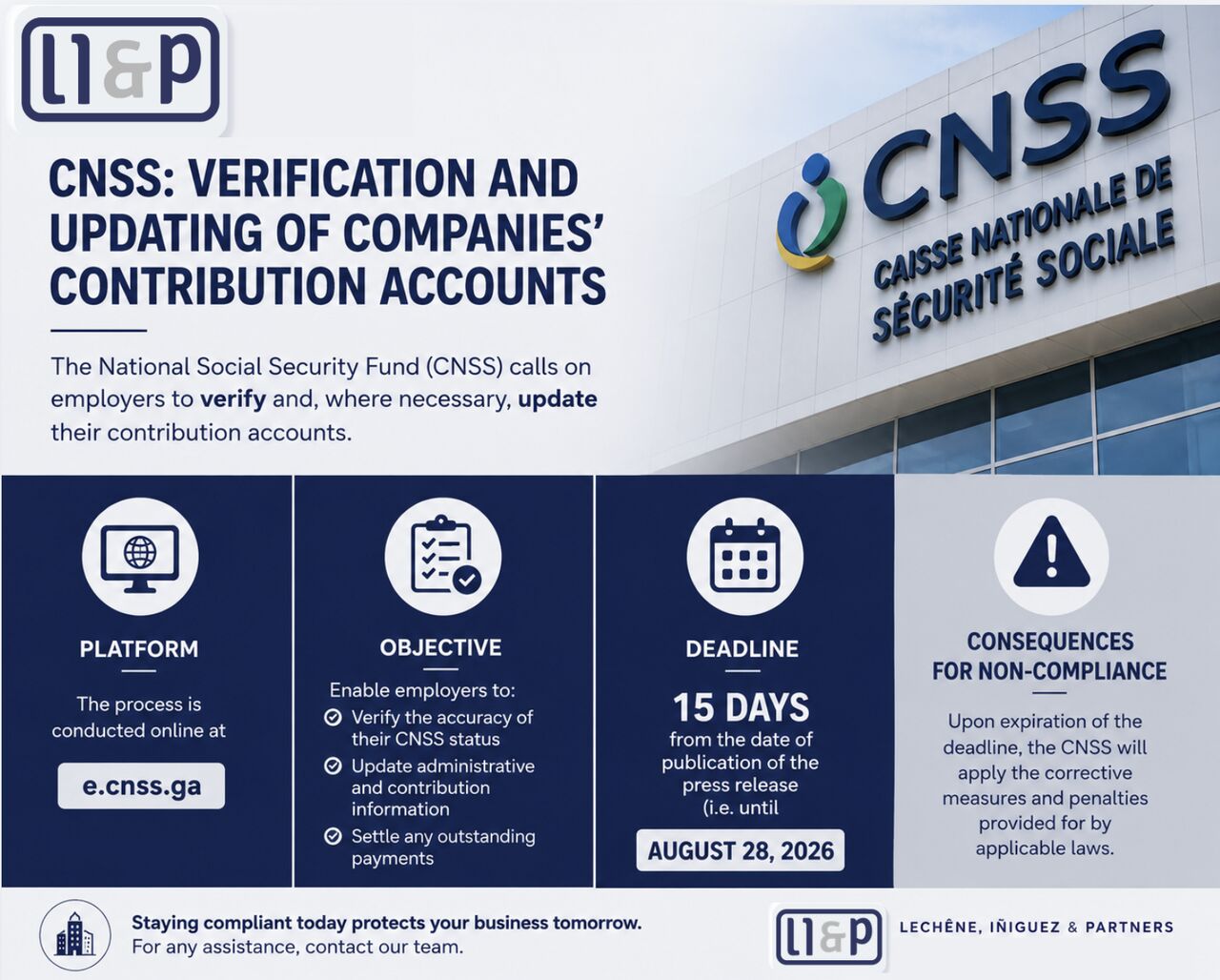
Gabon’s Caisse Nationale de Sécurité Sociale (CNSS) issued a communiqué in August 2026 calling on all employers to verify and, where necessary, update their contribution accounts. The process is conducted online via the e.CNSS portal and covers four areas: confirming the accuracy of an employer’s CNSS status, updating administrative and contribution information, regularising outstanding obligations, and ensuring accounts meet applicable compliance requirements.
CNSS gave employers 15 days from the date of publication to act, setting a deadline of 28 August 2026. That deadline has now passed. Critically, the communiqué states that CNSS reserves the right to apply corrective measures under applicable legislation once the window closes — meaning non-compliant employers may already be exposed, even though no fixed date now applies going forward.
This is not the first time CNSS has used a compliance sweep of this kind, and enforcement follow-through has varied. What is consistent is that employers who proactively regularise before any enforcement action begins are in a materially better position than those who wait to be contacted.
What this means for clients
Employers operating in Gabon — including foreign entities with local payroll obligations — should treat this as an active compliance item rather than a missed window with no consequence. Practically, this means logging into e.CNSS to check current standing, reconciling any discrepancies between reported and actual contributions, and documenting the regularisation steps taken in case CNSS follows up. Given the reference to “corrective measures provided for under applicable legislation,” employers with known gaps in their contribution history should treat this as a priority rather than routine housekeeping. Where an employer’s CNSS position is unclear or contested, legal input before making a submission can help avoid inadvertently admitting to non-compliance that CNSS was not otherwise pursuing.
Note: LI&P has not been able to independently confirm whether CNSS has begun applying corrective measures post-deadline as of publication — clients with specific exposure should seek a direct compliance check.